Friday, March 4, 2016

I SPY at Left Coast Crime, Phoenix


At the Left Coast Crime conference in Phoenix last week, I was assigned to appear on the “I Spy” panel with authors Art Kerns, Jeff Layton, Ryan Quinn, and moderator Annette Rogers. I’m a devout reader of espionage novels and have written a few…which got me thinking about the genre and what it’s really about. Spy fiction fascinates us because it deals with timeless themes of love, power, revenge, greed, ego, sacrifice, both the idealistic and dark sides of our nature. It’s about our world, the secrets and lies, conspiracies and plots that take place behind the scenes and impact us all.

As practiced by Kipling, Joseph Conrad, Graham Green, John Le Carré, and Alan Furst, the genre was traditionally about great power rivalry. The end of the Cold War cracked open the former spy v spy plot line with the emergence of rogue states, international criminal organizations, global terrorist networks—as in The Riviera Contract, by panel-mate Art Kerns—and technological sabotage and espionage, a theme of Ryan Quinn’s End of Secrets, about a rogue domestic spying program. Even former ideological enemies may find themselves on the same side as in Jeff Layton’s The Good Spy.


 My novel, Stinger, is an end of the Cold War spy thriller set during the Soviet-Afghan War in the mid 1980s. The action opens with the disappearance of six U.S. Stinger missiles that have secretly found their way to Peshawar.

How did I become interested in this genre? I started traveling at a young age, and the places I had read about or even truthfully never thought about became real. Their peoples became real. I will never forget Mohammed the waiter in Gilgit, in Pakistan’s far north, who took us to his home where he introduced us to his wife and daughters and served us tea under a picture of Ayatollah Khomeini, and yet he was not our enemy. We are all humans after all. I think about him as a minority Shiite in Pakistan. What has happened to him under Taliban control?

So I started reading the newspaper differently. And stories started to emerge, conflicts, characters. An article about a collegial meeting of former spies in SF led directly to Stinger.

I’m interested in the cusps of history and how the intrigue and conflicts affect my characters, e.g., a Hollywood actress and Cambridge-educated Maharaja at the end of the British Raj in India (my not yet published novel, The Star of India); an American businesswoman and Russian music conductor during the desperate last days of the Cold War in Russia (another new novel, A Conspiracy of Lies). And in Stinger, the last battleground of the Cold War, the conflict of a rogue CIA officer and SF journalist, each with secret agendas.

I’m interested in borderlands and often there’s a place on a map that calls to me. For Stinger, it was the Khyber Pass and cross-border tribal lands of Afghanistan and Pakistan. The Mekong region of SE Asia was the focus of Into the Fire, my latest book. After her adopted Chinese daughter is kidnapped, a woman reunites with her former case officer to mount a desperate search that takes them up the Mekong into southern China. 

At the conference, I met author Chris Holm. His tattoo has become my motto.


Sunday, December 20, 2015

Use Your Words


From Here to Eternity
That’s what they tell little kids. Use your words, not your hands. As a writer, I use them both, my hands channeling words and images via my keyboard. I have not posted here for awhile, busy finishing two big manuscripts in the past year and pushing halfway through the third. Having worked on these three projects for what seems like an eternity, I set myself a goal about fifteen months ago to get them out in the world. I have my editor’s notes on the last one but am taking a holiday break. 

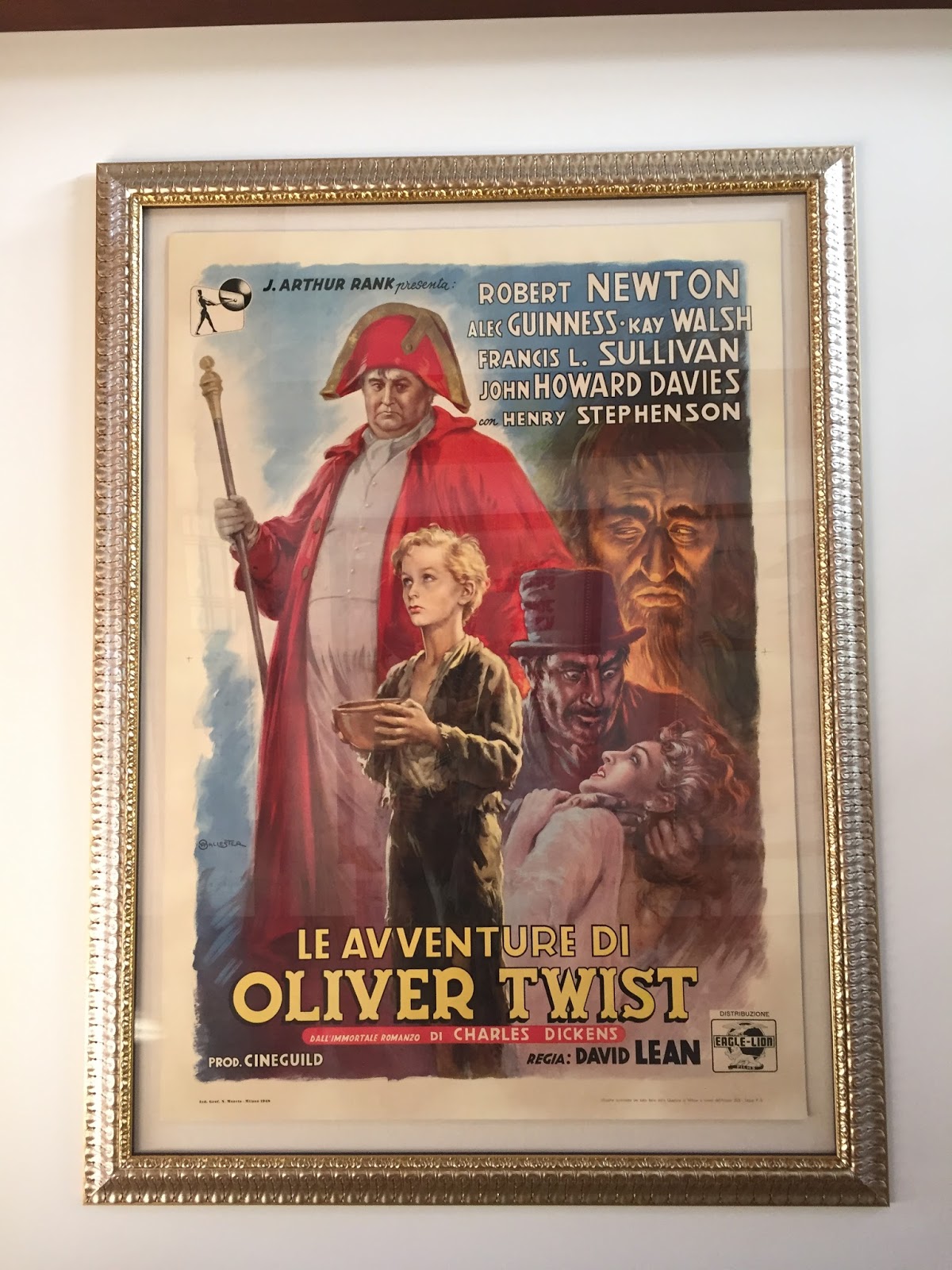
(The Adventure of) Oliver Twist
In the meantime, I seem to have used up all my words (temporarily), and so offer you some wonderful images. Thanksgiving weekend, we went to a screening of Mission Impossible at Lucas Films in San Francisco and as much as I enjoyed the movie, I was even more smitten with these old French and Italian film posters. 

The Nightmare of Dracula (released in the US as The Horror of Dracula)
Creature from the Black Lagoon
The Bat
The Man Who Shot Liberty Valence
The Searchers

Thursday, October 15, 2015

Bouchercon Love


Leaving Daisy to guard the home fires


and Marco Polo to read my latest manuscript


I set off to Raleigh, North Carolina for Bouchercon.


“Go for the books, return for the love,” as blogger extraordinaire Kathy Boone Reel says. After a year of hard writing, I’m ready!


Bouchercon is an annual convention of writers and readers of the mystery-thriller-suspense genre. It’s a very broad, inclusive tent and all are welcome. This is a quirky group and, as Kathy says, we put the fun in dysfunctional! The event is run by generous volunteers, including writer-chairman Jeffrey Siger and Madame Mystery, Janet Rudolph. Over the past few years I’ve made some true friends, including authors Deborah Crombie, Susan Shea, (Terry Shames, making mischief elsewhere), and Karin Salvalaggio (who took the photo).


Every year there are great panels, with discussions ranging from historicals to thrillers post-Snowden. Sometimes I never get out of the hotel, but this year vowed to see a bit of the city. Karin had taken a Segway tour of Raleigh before I arrived and thus knew it all! Along with the delightful Ben McPherson, a British writer living in Oslo, we went exploring. Set in the center of town, the Bicentennial Mall is an expansive grassy area of government institutions and museums. The modern State Legislative Building was designed by Edward Stone who also did the Kennedy Center in DC and the US Embassy in New Delhi. Across the street, outside the Museum of Natural Sciences, is an enormous globe. Of course I had to get a picture there. (Instagram photo courtesy of Karin.)


In the State Capitol, we discovered Antonio Canova’s sculpture of “Giorgio Washington” as Roman general. He is seen writing his Farewell Address.


Here is Karin next to her book Bone White Dust at the downtown Raleigh library.


You run into everyone at the bar, where author James Ziskin presides with humor and warmth. Where I heard thrilling author news from Robin Burrell and got to be one of the first to hug her. The hotel lobby is another good place to encounter people you’ve known only via their writing or social media. I was excited to meet the brilliant wit, Ali Karim from the UK, as well as writer Chris Pavone, and (not pictured, but you can imagine her red lipstick, Deanna Raybourn.)


I cheered as dear friends won awards, including Julia Dahl, Lori Rader-Day, Catriona MacPherson, and spent time with future winners, no doubt. We shared some great meals 
   

great drinks


and great Bouchercon love.

Next year, New Orleans! 

Until then, it’s me and my other BFF, Daisy Mae.

Wednesday, September 23, 2015

It’s All in a Name


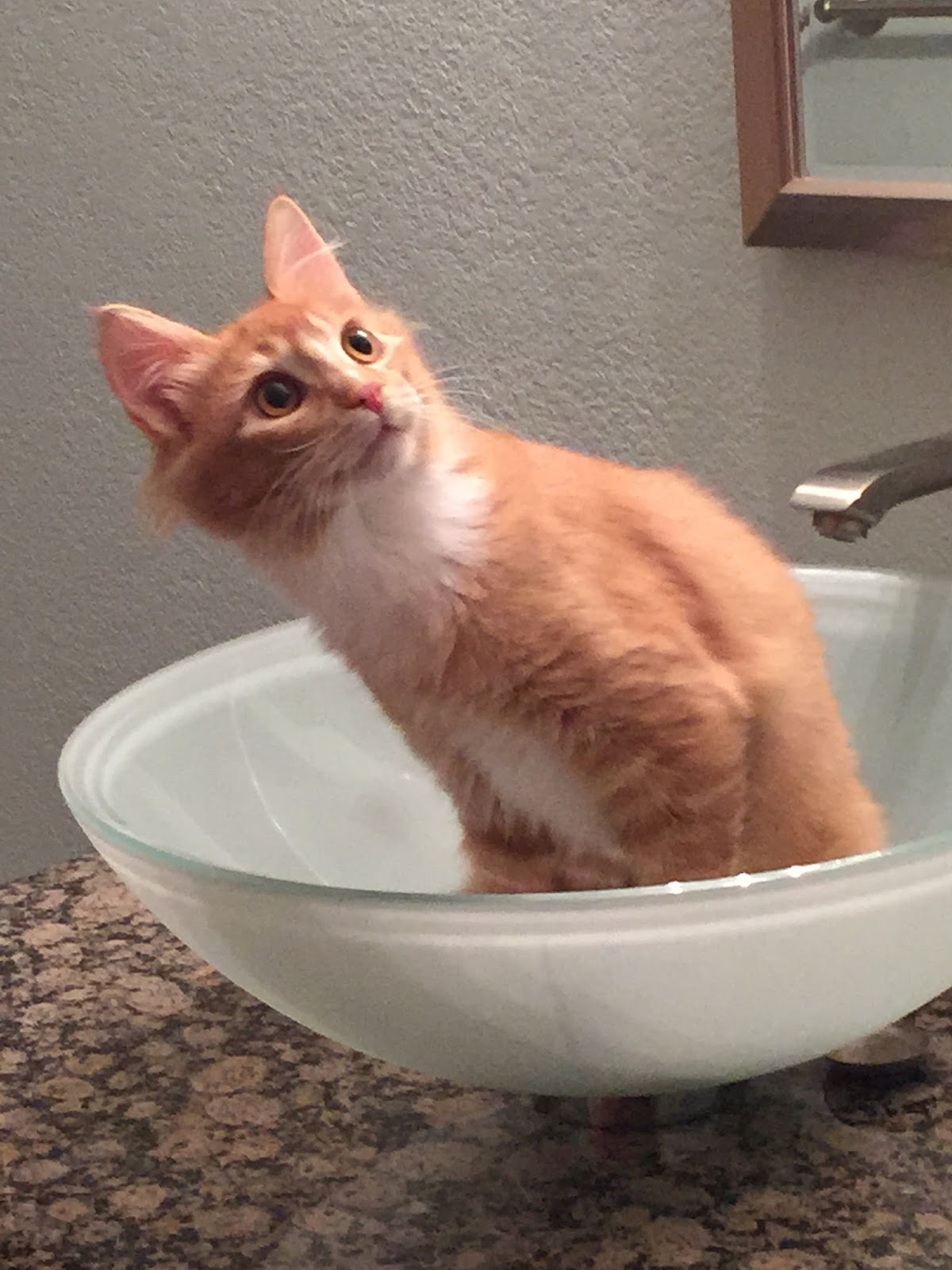
At our last book club, a friend mentioned the feral kitty she’d trapped, a little orange fellow about three months old. Two days later, he had moved in to our house. Thus ensued the Great Name Debate. We liked Mango for the color and associations with India and our favorite fruit.


Then the Daughter decided the name was too cutesy. Following more lengthy debate, we settled on Marco Polo, which also worked as I knew him from past life on the Silk Road. Or maybe I was him. 

Like his namesake, Marco is a gutsy character. He does not take no for an answer. Doing what he wants, when he wants. For those with feline experience, this should come as no surprise. However I’ve never had a cat and find him endlessly entertaining with his stalking-sharp eyes, determined pounces, and strong will. His energy! 


His curiosity! 


He lives upstairs in the college Daughter’s bathroom, jumping over the gate after three days. 


This led him into our bedroom, Daughter’s bedroom, and my office.


There have been incidents with our twelve-year old mutt, Daisy Mae, an only “puppy” until now. It has been traumatic for her, especially when Marco leaps on the bed which has been denied her all these years. I think Daisy doesn’t know what hit her, so we are giving our girl lots of extra love.


Marco is inquisitive about her too, but Daisy has remained aloof, refusing to meet his eye. It appears, though, that she is resigned to things never being the same. 


My “trapper” friend tells me that cats born of a feral mother are taught to be wary, stealthy, and sly. Marco is definitely a survivor, always hiding and poking his head out to make sure the coast is clear before darting onward.


After about two weeks, Marco ventured downstairs...


...and began his explorations in the larger world.


It has been a month now and he is gazing out the window with great expectations. 

The other day I told my daughter she was right about the name, that Marco is far too determined and tough to be a Mango. 


“I told you!”


PS. My Turn. 
Just checked: She’s writing about me. Again. Has she nothing else to think about it? And all this posing gets tedious. Still, I’ve made a lot of new friends through her. And an extended family on Twitter: My Godmother @LilyMarsWrites, Uncle @michaelmagras, and Auntie @ChristinaHolz, but I like to call her Chachacha. Yesterday I found long-lost cousin @nandelabra, Nandini to you. Eternally grateful to my foster mom @YogaWithCheryl ❤️❤️

So, in gratitude, I’ll give her some notes.


And in the hope of peace in our times, I’ll reach out to Daisy.


Wednesday, September 2, 2015

Queen of International Espionage


Way back when, an editor read one of my early efforts at international intrigue, and called me a young Helen MacInnes. By young, I now realize he was being kind for I resembled her only in an aspirational way. Over the years, I remained curious, but never got around to her work.


When MWA-NorCal President Susan Spann requested author profiles for the newsletter, I decided this was the perfect kick in the butt to investigate MacInnes, dubbed by the New York Times, “the queen of international espionage fiction.” Her work spanned a tumultuous chunk of the twentieth century from WW2 through the Cold War, creating suspense novels set against the major political events of her day.
A formidable woman, she was born in 1907 and as a translator, she and her Oxford professor husband, Gilbert Highet, traveled widely in Europe in the early thirties, viewing firsthand the rise of Nazism. At some point in those years he joined MI6, and served as a intelligence agent. The couple moved to New York in 1937 where he was part of a joint MI5, MI6, and SIS operation based in Rockefeller Center, to enlist America’s support in the war.
 MacInnes used her proximity to the clandestine world to create an insider’s view of how it is. A great traveler and brilliant researcher, she had a sharp eye for the telling detail. Her ability to paint a scene and use setting to convey emotion is peerless.


The playwright in North from Rome is hiding outside a Tuscan villa, preparing to rescue his lover from a conspiracy of Communist-linked smugglers. “Around him, the cicadas had become a permanent background of sound, no longer heard. The violence of brilliant light and black shadow, the contrast of scarlet flowers against blue sky, the heavy scent of sun-warmed fruit, the jagged rhythm of the yellow butterflies were no longer seen or felt. Nothing existed, nothing, except the silent house and the moving hand of his watch. Nine minutes now…”
Her characters are often ordinary people who become entangled in larger geopolitical forces. In another Cold War novel, Ride a Pale Horse, a journalist at a Prague peace conference ends up carrying top-secret documents from a potential defector to Washington. However, she soon learns there is a mole in the CIA.


Over her career, MacInnes wrote twenty-one espionage novels, of which four became movies. In one of them, Assignment in Brittany, a British man impersonates a French resistance fighter hospitalized in England in order to collect intelligence in a German-occupied Breton village. Just as the author was losing me that even the man’s mother is fooled, Madame confronts the hero in a sly twist—he is generous and brave, her son is not!


MacInnes has her flaws. Her work often feels overwritten with much annoying head-hopping, but her descriptions of the landscape are gorgeous and she uses the terrain to great effect in well-developed action scenes. Transporting a wireless transmitter,  the British hero and his young guide pass through a hidden passage in the ramparts of Mont St. Michel…“And then the narrow slab of rock moved slowly aside. The cool clean breeze from the sea ended the feeling of suffocation. In front of them was a panel of night sky, and the gentle movement of small trees swaying like black-shawled women at a funeral.” They are outside the great wall and will soon reach the north shore of the island. But the tide is rising and Nazis are everywhere.
The world is a dangerous place and Helen MacInnes takes full advantage of it.